MONIAC

AP Macro 2.1
Households Firms Treasury Savings pool Rest of world M 0 X 0 Income · wages, rent, interest, profit · 0 Consumer spending C 0 C + I + G 0 S 0 T 0 I 0 G 0 product market ▸ ◂ factor market GDP each lap Phillips curve short run · long run · inflation ↑ unemployment → Unemployment Inflation Price level Interest rate Dollar
RIGHT

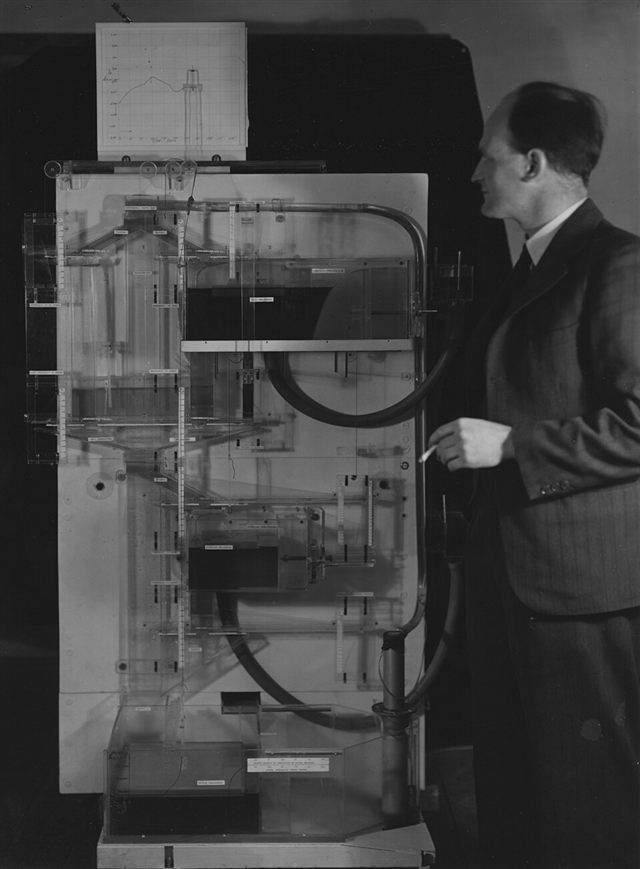
Bill Phillips stands beside his machine of clear tanks and pipes. A pen on top has drawn a curve on graph paper.
Bill Phillips and his machine at the London School of Economics, about 1958. LSE Library.
MONIAC
Run an economy built from water, pumps and pipes.
The real machine

In 1949 Bill Phillips, a New Zealand student at the London School of Economics, built a model of the British economy in a garage in Croydon. He called it the MONIAC, the Monetary National Income Analogue Computer.

Water stood for money. A pump lifted it to the top as income. It drained away into tanks for taxes, saving and imports, and flowed back in as government spending, investment and exports. A pen on top drew GDP on paper. About 12 to 14 were built, and Phillips later gave his name to the Phillips curve.

What you do

Seven stages each add a pipe, from a closed loop to a second economy abroad. Then eight puzzles test what you learned.

The real machine

In 1949 Bill Phillips, a New Zealand engineering student at the London School of Economics, built a model of the British economy out of water, tanks and pumps in a garage in Croydon. Walter Newlyn helped build it. It was called the MONIAC, or the Phillips Machine. Phillips later drew the Phillips curve.

About 12 to 14 were built. Surviving machines are at the Science Museum in London, Cambridge, Leeds and the Reserve Bank of New Zealand.

This game

Each lap, households get the income in the top pipe. Taxes come off first. They save the MPS share of what is left and spend the rest. Firms take in that spending plus the investment and government pumps, and that total is the next lap's income.

Taxes are a set amount each lap, as in the AP course multipliers. Stage 4 switches to a tax rate, which the real machine used. Imports here are a set amount that moves with the dollar, so the multiplier stays 1 ÷ MPS.

In stages 4 to 7 one lap is a quarter of a year. Prices rise when GDP runs above full employment and fall when it runs below.

The machine uses one interest rate. AP separates the nominal rate in the money market from the real rate in loanable funds. Here the Fed rate moves both.

Machine mastered

You ran all seven stages of the machine:

Phillips built the first machine in 1949 from a few hundred pounds of parts. Economists used it to teach and to test policy for years after.